
Scammed out of crypto? What to do in the first 72 hours, step by step
Published: Last reviewed: Editorial policy
In the first 72 hours, do five things in order: stop sending any more money, secure your accounts and wallets, save all evidence, report to the exchange, the stablecoin issuer if relevant and the police, and avoid anyone who contacts you offering recovery. Speed helps because some platforms can act only while funds remain traceable, but no one can promise a result.
Questions about your case? Message us:
Hour 0 to 2: stop the loss
Stop all payments to the scammer, even if they say a final fee will release your funds. This is a common second stage of the same scam. Do not send anything else, and do not take out a loan to pay.
Then secure what is still yours. If you shared a seed phrase, an access code or screen access, assume the wallet is exposed. Move remaining assets to a new wallet created on a clean device, and change passwords on email, exchange and phone accounts.
- Disconnect remote access tools and uninstall any app the scammer asked you to install.
- Enable two factor authentication using an app, not SMS, on your email and exchange accounts.
- Revoke token approvals for the affected wallet if you can do so safely.
- Call your bank if fiat payments were involved. Ask whether a recall is possible.
Hour 2 to 12: preserve the evidence
Evidence disappears fast. Scam sites go offline and chat accounts get deleted. Capture it now, before you do anything else with the case.
Do not delete conversations in anger. Take screenshots with visible dates and keep the original messages. Write the story as a timeline while your memory is fresh.
- Transaction hashes, wallet addresses, amounts and dates for every transfer.
- Screenshots of the website, the app, the chats, the emails and the profiles used.
- The web addresses and the names, usernames and phone numbers the scammer used.
- Bank or card records for the payments that funded the transfers.
- A written timeline of who contacted you, what was promised and what you sent.
Hour 12 to 36: report to the right places
Report in parallel, not one after another. Each report creates a reference number, and those numbers matter later.
If your funds went through an exchange, write to its fraud or compliance team with the hashes and the timeline. If the stolen asset is a centrally issued stablecoin, the issuer may be able to act on a valid request. These platforms may freeze funds if they are still there, but they decide on their own.
- The exchange you sent from, and the exchange that received the funds if you can see it.
- The police or the national cybercrime unit in your country, with the evidence list.
- Your bank or card issuer for any fiat part of the payment.
- The platform where you met the scammer, such as a social network or dating app.
Hour 36 to 60: map where the funds went
A blockchain trail can show where stolen funds moved. Look up the destination address on a block explorer and note where the funds went next. If they reached an exchange deposit address, tell that exchange and the police.
A formal analysis by an independent specialist can turn the trail into a report that police and platforms can use. It does not return the funds by itself. It supports a request.
Hour 60 to 72: beware of recovery scammers
Victims are targeted again within days. Messages arrive on social media, by email and by phone from people claiming to be investigators, hackers or lawyers who can retrieve your funds for a fee.
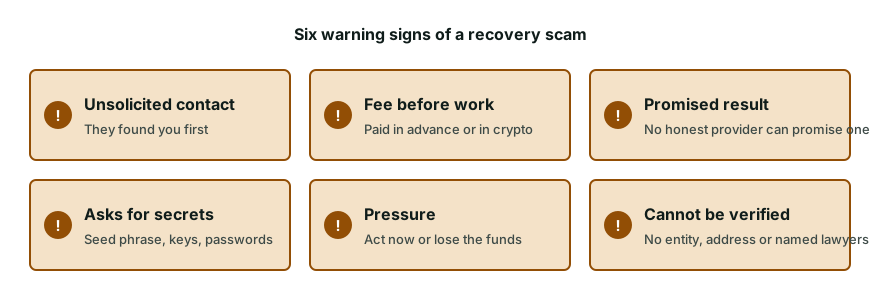
Do not answer unsolicited offers. Real providers do not need your seed phrase, do not demand upfront payment before they tell you whether they can help and do not promise results. Our separate guide lists the red flags in detail.
What happens after the three days
Keep a case file with every report number and every reply. Expect slow progress. Police and platforms may take weeks to respond, and many cases do not end with funds returned.
If the sum is significant, you can ask us for a free assessment. We tell you honestly whether the evidence supports a route, prepare the package and coordinate independent lawyers and analysts. We cannot recover the funds ourselves and we never ask for a seed phrase, private key or password.
Common questions
Is it too late if more than 72 hours have passed?
No. Speed helps, because funds may still sit at a platform that can act. But the steps are the same later: preserve evidence, report, and ask for an assessment. Some routes become harder with time, so start now.
Should I confront the scammer or demand a refund?
No. Contact warns them to delete evidence and gives them a chance to ask for more money. Stop replying, keep everything you have and move your efforts to reporting and securing your accounts.
Will the police recover my crypto?
They may investigate, and in some cases authorities can seize funds. Results vary widely by country and case, and recovery is not common. File a report anyway, because the reference number helps with banks and platforms.
Can an exchange reverse a blockchain transfer?
No. Blockchain transfers cannot be reversed by anyone. An exchange can sometimes freeze funds that are still on its platform, if it receives a valid report in time, but it is under no duty to do so.
Someone says they can hack the scammer's wallet. Is that real?
Treat it as a scam. Hacking someone's wallet is a crime, and no honest provider offers it. The person is most likely a second scammer who wants an upfront fee or your seed phrase.
How we can help
- Stolen crypto tracing and freeze requests. Trace stolen crypto, send freeze requests to exchanges and issuers, file a police report.
- Blockchain analytics report. A source-of-funds report from transaction tracing, ready for a compliance team.
- DeFi exploit and bridge hack response. Tracing, alerts and reporting after a DeFi exploit, bridge hack or malicious approval.
- Stablecoin issuer appeals. Prepare a documented appeal to Tether, Circle or another stablecoin issuer.
Information on this page is general and not legal advice.