
Crypto wallet unblocking across networks, for cases from USD 50,000
Published: Last reviewed: Editorial policy
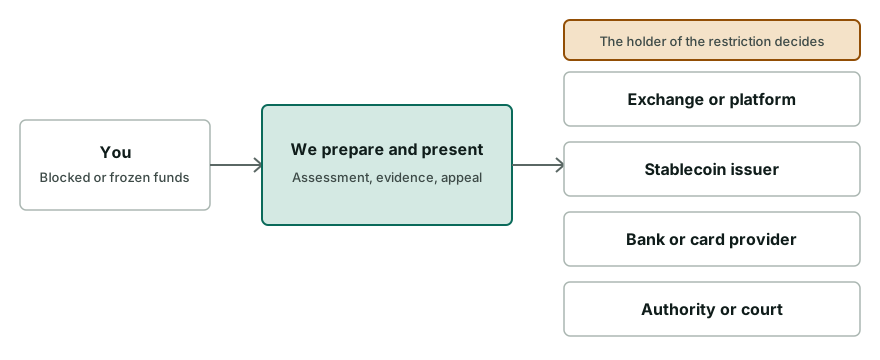
A wallet is unblocked only by whoever controls the restriction: a token issuer, a custodian, an exchange, a payment service or an authority. We cannot unblock it ourselves. We prepare the case, put it in front of the right party and coordinate independent specialists and lawyers. Because that work is costly, we take cases from USD 50,000. We cannot guarantee any outcome.
Questions about your case? Message us:
Minimum case size: USD 50,000. We take wallet unblocking cases from this value, because the specialist and legal work involved is not economical below it.
This is for you if
- Your wallet or address is frozen, blacklisted or flagged and a large balance is stuck
- The restriction sits with an issuer, custodian or service, not with a technical fault
- You hold funds on more than one network and the restriction affects several of them
- A smaller attempt through standard support has failed and the amount justifies formal work
- A business needs a frozen treasury or customer wallet reviewed
Typical situations
- A stablecoin balance at your address is frozen by its issuer
- A custodian holds a wallet in a restricted state after a compliance review
- An address was flagged by screening tools and services now refuse to accept its funds
- A wallet on one network was frozen and funds bridged from it face the same flag
- A business wallet was restricted after a counterparty was linked to a sanctioned or fraud address
- A hold followed an authority request and the holder cannot get information
What we do
- Identify who actually controls the restriction
We trace the restriction to its owner: issuer, custodian, exchange, payment service or authority. Unblocking happens only through that party, so every later step depends on getting this right.
- Assess viability and whether the case fits our size
We review the amount, the facts and the likely ground. We tell you honestly if the route is weak, or if the case is below the size where specialist and legal costs make sense.
- Prepare the evidence and the analysis
Independent specialists build a transaction history and source-of-funds analysis. We combine it with your identity, ownership and acquisition records into one consistent case file.
- Present the case to the party that decides
We draft the formal request or appeal and present it through the proper channel, with exhibits. Where the restriction rests on legal process, independent licensed lawyers handle that part.
- Coordinate across networks and parties
If funds or flags span several networks or services, we keep one timeline and one set of documents so each party sees the same facts and your story does not contradict itself.
How the case runs
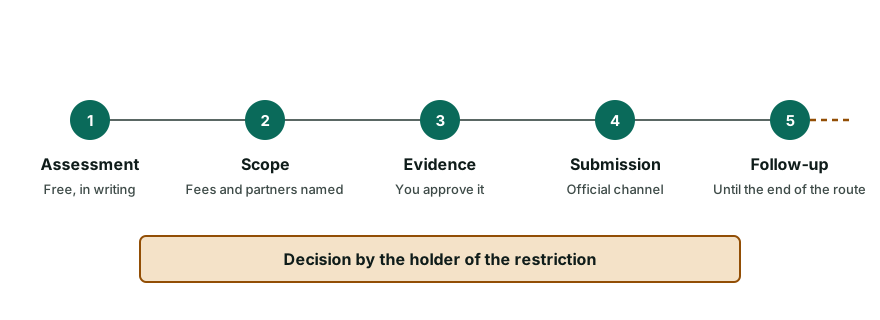
- Free assessment
You describe the wallet, the networks and what you know. We tell you in writing whether the case fits and whether it meets the minimum case size.
- Written scope and fee
You receive the scope, the fee model and the independent specialists and lawyers involved before you pay anything.
- Case preparation
Specialists analyse the chain history. You provide documents through a secure channel and we resolve gaps before anything is sent.
- Presentation
The case is presented to the issuer, custodian or service, or to the authority through counsel. You receive copies and all reference numbers.
- Follow-up and closure
We track responses, handle follow-up questions and tell you plainly if the route is exhausted.
What to prepare
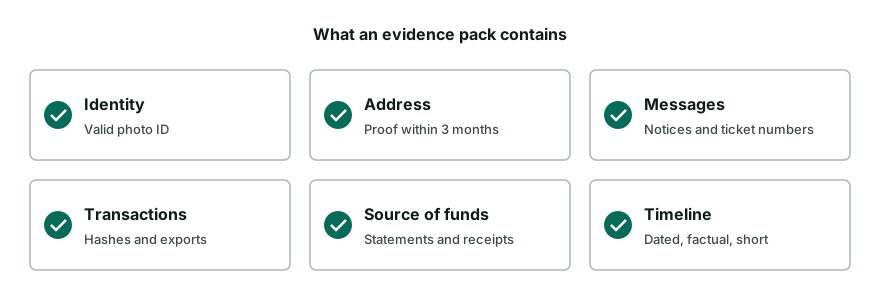
- The frozen or flagged wallet addresses and the networks they sit on
- Hashes of the main inbound and outbound transactions
- Proof that you control the wallet, provided without sharing keys or a seed phrase
- Government photo ID and proof of address, or company documents for a business
- Records showing how the funds were acquired, such as bank transfers, invoices and exchange exports
- Any notice, email or ticket from the issuer, custodian, service or authority
- A written timeline of events
What we cannot do
- We cannot unblock a wallet ourselves. Unblocking happens through whoever controls the restriction, and that party decides.
- We cannot force an issuer, custodian, service or authority to act, and we do not promise a result or a timeline.
- Cases start from USD 50,000. Below that, specialist and legal costs usually outweigh what a case can reasonably recover, so we say so instead of taking your fee.
- We will not help alter or backdate any document, and we do not accept cases we believe have no realistic route.
- We will never ask for your seed phrase, private keys, passwords or remote access.
How long it takes
Timelines vary widely. Issuer and custodian reviews can take weeks, and anything involving legal process can take months. We give an estimate after the assessment and update it.
Fees
The assessment is free. We take cases from USD 50,000 because the work needs paid analysts and often lawyers. Fees are quoted in writing after the assessment, and no fee is asked before we say whether we can help. Fees →
Questions people ask
Who can actually unblock a frozen wallet?
Only the party that placed or controls the restriction. For a stablecoin that is usually the issuer, for a hosted account it is the custodian or exchange, and for a hold by authorities it is the authority or a court. No third party can override them.
Why is the minimum case size USD 50,000?
A serious case needs blockchain analysts, document preparation and often a licensed lawyer. Those costs are real. Below this size they would take most of what could be recovered, so it is more honest to say no early.
Is the minimum a fee?
No. It is the smallest balance we take on. The assessment is free, and the fee model is quoted in writing after it. You pay nothing before we tell you whether we can help.
What if my case is smaller than USD 50,000?
Other pages on this site may fit better, such as exchange account unblocking or issuer appeals. You can also do much of the groundwork yourself using our guides. We will say plainly if we cannot take the case.
Do you need my private keys to unblock a wallet?
Never. Proof of control can be shown without keys, for example by signing a message. Anyone asking for a seed phrase or key is not working in your interest, and you should stop contact.
Can you unblock the same wallet on every network?
A freeze usually applies per token and per network. A wallet may be restricted on one chain and free on another. We map each network separately and tell you which restrictions exist.
Related situations
- Crypto freeze diagnosis. Work out who froze your funds and what can realistically be done next.
- Stablecoin issuer appeals. Prepare a documented appeal to Tether, Circle or another stablecoin issuer.
- Blockchain analytics report. A source-of-funds report from transaction tracing, ready for a compliance team.
- Crypto frozen by authorities. Assets held by authorities: we coordinate independent licensed lawyers. No legal advice.
Read next
Sources
Official or authoritative pages this page is based on. Pages change, so check the source for the current wording.
Information on this page is general and not legal advice.