
USDT or USDC address frozen? Preparing an appeal to the issuer
Published: Last reviewed: Editorial policy
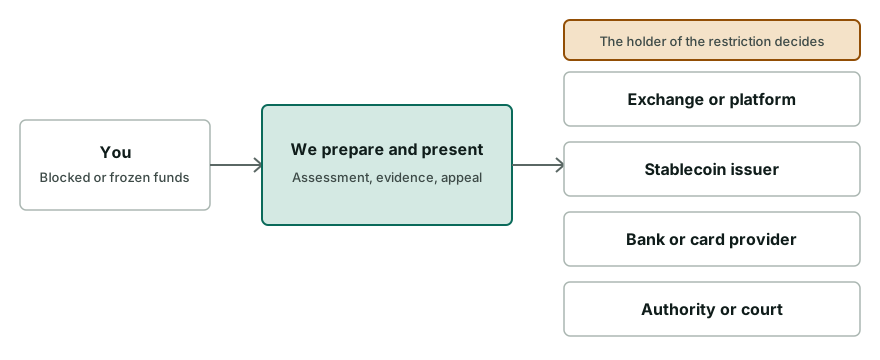
When a stablecoin issuer such as Tether or Circle freezes an address, the token cannot be moved even though you hold the wallet. Issuers generally act on legal process or a compliance flag, so a casual support ticket rarely works. The realistic route is a documented appeal with evidence, sometimes with counsel. We prepare and present that case. The issuer decides, and we cannot force it to unfreeze anything.
Questions about your case? Message us:
This is for you if
- Your USDT or USDC will not move and you suspect the address is blacklisted
- A block explorer or wallet shows a freeze status on your address
- You received tokens from someone else and the address was frozen afterwards
- An exchange told you the issuer froze the funds and gave no further detail
- A support ticket to the issuer got a template answer or no answer
Typical situations
- Tokens were received from an address that was later linked to fraud or sanctions
- The freeze followed a request from an authority, and you were not told
- Your wallet was frozen after a peer to peer trade with a counterparty that turned out to be flagged
- A business wallet holding customer payments was frozen with no explanation
- The funds are held at an exchange deposit address that the issuer restricted
- You were the victim of a scam and the frozen address is not yours, but you want to claim the funds
What we do
- Confirm that the issuer is the one holding the restriction
Before any appeal, we check the on-chain status of the token at your address and rule out other causes. If the issuer is not behind the block, an appeal to it would only waste time.
- Work out the likely ground
A freeze is often linked to a law enforcement request, a sanctions screening hit or an internal compliance flag. We read the history of the address and its counterparties to form a reasoned view of the likely ground.
- Build the evidence file
We assemble proof of how you obtained the funds, a transaction timeline, identity and ownership evidence, and where useful a tracing report from independent analysts. Everything is checked for consistency before it is sent.
- Draft the appeal and present it
We write a factual appeal that states who you are, what happened, what you ask for and what documents are attached. We help submit it through the issuer's official contact route and keep the reference numbers.
- Bring in counsel where the facts require it
If the freeze is tied to legal process, an appeal alone may not be enough. We coordinate independent licensed lawyers who advise you and act where needed. We are not a law firm.
How the case runs
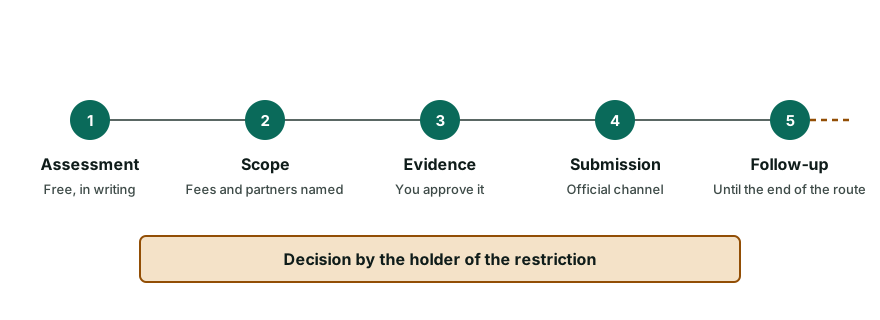
- Free assessment
You share the address, transaction hashes and anything the issuer or exchange told you. We say in writing whether an appeal looks realistic.
- Written scope and fee
If we proceed, you receive the scope, the fee model and the independent specialists or lawyers involved before you pay.
- Evidence and drafting
You provide documents through a secure channel. We prepare the appeal and the exhibits and you approve the final version.
- Submission
The appeal is sent through the issuer's official route. You receive a copy and every reference number.
- Follow-up
We track responses, answer follow-up questions and tell you plainly when a case has reached the end of what can be done.
What to prepare
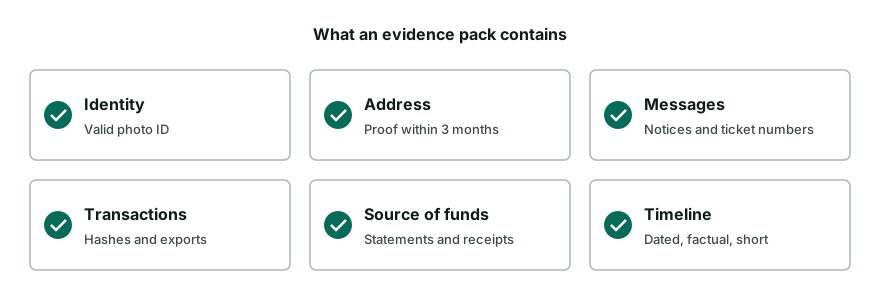
- The frozen wallet address and the token contract concerned
- Hashes of the transactions that brought the tokens to the address
- Government photo ID and proof of address
- Records of how the funds were acquired, such as bank transfers, purchase receipts or invoices
- Any message from the issuer, an exchange or an authority about the freeze
- Chat logs or a contract for a trade, if the tokens came from a counterparty
- A short written timeline in your own words
What we cannot do
- We cannot force an issuer to unfreeze an address. The issuer decides, within its own rules and the legal orders it receives.
- If a freeze rests on a court or authority order, only that authority or the court can change it, usually through a lawyer.
- We do not promise a result or a timeline, and we do not accept a case we believe has no realistic route.
- We will not help you alter or backdate any document. If evidence does not exist, we say so.
- We will never ask for your seed phrase, private keys or passwords.
How long it takes
Issuer responses can take weeks or longer, and some appeals get no reply. Cases tied to legal process move at the speed of that process. We give a rough estimate after the assessment.
Fees
The assessment is free. After it you receive a written scope and fee model. Any lawyer's fees are quoted separately by the lawyer. We do not ask for a fee before we say whether we can help. Fees →
Questions people ask
Can Tether or Circle unfreeze my address?
Technically an issuer can control tokens it issues, but whether it does depends on its own decision and any legal order behind the freeze. We cannot say what a specific issuer will do. We prepare the strongest honest case we can.
Why do issuers freeze addresses?
Common reasons are a request from law enforcement, a sanctions match or a compliance flag linked to fraud. The issuer often does not tell the holder which one applies, so the first step is to form a reasoned view from the address history.
Should I just email the issuer support?
You may, but a short complaint rarely helps and a weak first message can make later steps harder. A structured appeal with evidence is usually a better first contact. Keep every reply in writing.
Do I need a lawyer for a stablecoin freeze?
Not always. If the freeze is tied to a court or authority request, or the amount is large, a lawyer is often needed. We coordinate independent lawyers and tell you when that point is reached.
What if the frozen address is not mine?
If you are a victim of fraud and the funds sit at someone else's address, the route is different. It usually runs through a police report and legal process, not a holder's appeal. We explain which path fits your facts.
Will moving my other funds away help?
Moving unrelated funds can be reasonable, but sending anything to or from a frozen address may link new addresses to it. Ask us before making transfers that could worsen the picture.
Related situations
- Crypto freeze diagnosis. Work out who froze your funds and what can realistically be done next.
- Crypto wallet unblocking. Frozen or flagged wallets: we prepare and present the case. Cases from USD 50,000.
- Crypto frozen by authorities. Assets held by authorities: we coordinate independent licensed lawyers. No legal advice.
- Blockchain analytics report. A source-of-funds report from transaction tracing, ready for a compliance team.
Read next
Sources
Official or authoritative pages this page is based on. Pages change, so check the source for the current wording.
Information on this page is general and not legal advice.