
Pig butchering and romance investment scams: how they work and what to do
Published: Last reviewed: Editorial policy
Pig butchering is a scam that builds trust first and asks for money later. It often starts on a dating app or social platform and moves to a crypto 'get rich' pitch. Victims often buy crypto on a real exchange and send it to an address the scammer controls. If you are in one now, stop paying, save everything, report it, and ignore anyone who offers to recover your money for a fee.
Questions about your case? Message us:
What the scheme is, in plain words
Pig butchering is slang for a long con. The scammer first builds a friendship or romance, then steers the talk to a crypto investment, and keeps the victim paying in. Agencies also call the same pattern a romance-investment scam. This guide uses both names.
The Canadian Anti-Fraud Centre says these schemes often begin with contact on a dating app or a social platform. After trust is built, the pitch turns to a crypto way to get rich. Victims often buy crypto on a reputable exchange and send it to an address that the scammer controls.
That detail matters. The name of a real exchange on your statement can feel like proof that the investment is real. It shows only that you bought crypto. Once it is sent to the scammer's address, it is effectively gone, and crypto payments lack the kind of fraud safeguards that card payments have. If any of this sounds familiar, read the warning signs below.
How it unfolds, stage by stage
The details change, but many cases follow the same arc. Use the table to see where you might be. The right-hand column shows what to notice at each stage.
The stage names are ours. The pattern comes from public warnings by consumer and law enforcement bodies, and every case differs.
| Stage | What happens | What to notice |
|---|---|---|
| First contact | A stranger writes to you on a dating app or social platform and is friendly and curious. | Someone you have never met takes a quick, warm interest in you and soon wants to move to a private chat app. |
| Building trust | Messages arrive every day, with photos, shared plans and talk of the future. The person avoids meeting in person or on a live video call. | A closeness that grows fast, and always a reason why you cannot meet. |
| The investment pitch | The person mentions a crypto opportunity, often a trading app or website that they say they or a relative use. | A new friend teaches you how to make money from crypto and offers to guide you. |
| First deposit and fake gains | You buy crypto and send it to an address or platform the person names. The platform shows rising profits. | The balance exists only on a web page or app that the scammer's side controls. |
| Bigger deposits | The person urges you to add more, sometimes from savings, a loan or a pension. | Urgency, and discouragement from talking to your bank, family or friends. |
| Withdrawal blocked | A withdrawal fails, or you are told to pay a fee, tax or deposit first. | A demand to pay before you can reach your own money, and a new reason to pay after each payment. |
| Recovery pitch | After the loss, someone contacts you offering to recover the funds for a fee. | Another stranger and another fee. The Canadian Anti-Fraud Centre calls such pitches a further layer of the same fraud. |
Warning signs you can check today
One sign alone can have an innocent explanation. Several together are a reason to pause, stop sending money and talk to someone you trust. If two or more of the signs below apply to you, go straight to the next section.
- You met the person online and have never seen them live, yet they already talk about money or crypto.
- They steer you to a particular trading app or website, and you cannot find independent information about it.
- The platform shows large gains quickly and makes it easy to deposit but hard to withdraw.
- You are asked to pay a fee, tax or deposit before you can withdraw your own balance.
- They ask you to send crypto to an address they provide, or demand crypto in the name of a government body. The Canadian Anti-Fraud Centre treats a demand for crypto in a government's name as a scam signal.
- They discourage you from asking your bank, your family or a financial adviser.
- They push you to act fast, or to borrow money to invest more.
If you are in one now: what to do
You are not the first, and the fault lies with the person who deceived you. Skilled scammers deceive careful people every day. What helps now is a short list of calm actions.
Reporting early can matter. The Canadian Anti-Fraud Centre describes a 2022 case in Winnipeg where a transfer of 17,000 dollars was clawed back after reports to both the centre and the police. Such outcomes are not the rule, and nobody can promise one, but they show why a fast report is worth making.
- Stop all payments, including fees, taxes and 'verification' deposits. Do not send a test amount to see whether withdrawals work.
- Do not confront the scammer or threaten them. Save every message first, then stop replying.
- Save the evidence: wallet addresses, transaction hashes, screenshots of chats, profiles and the platform, and your bank and exchange records.
- Call your bank and the exchange you used, and tell them what happened. They can act only on funds or payments they still control.
- Report to the police or the national fraud service. Our guide to reporting by country lists official channels in eight countries.
- Secure your accounts: change passwords, and remove any app or remote access tool that the scammer asked you to install.
- Tell someone you trust. Shame keeps many victims silent, and silence helps the scammers.
How recovery scammers target victims afterwards
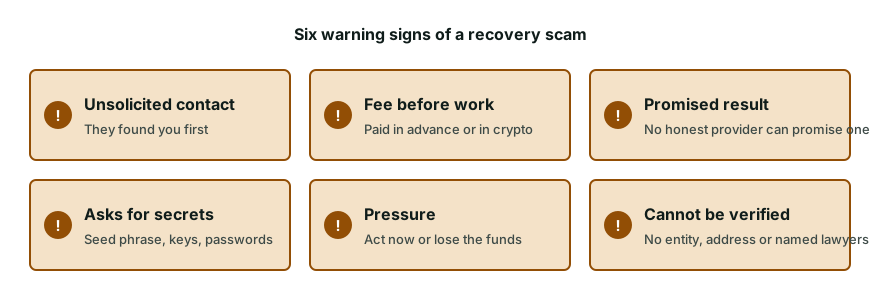
Losing money to one scam can make you a target for a second. People who lost money to an earlier scam are often contacted by someone offering to recover it, sometimes within days.
The FBI's IC3 warns about fake law firms that claim you are on a government list of scam victims and that legal action can recover your money. The Canadian Anti-Fraud Centre describes recovery pitches that charge a fee as a further layer of the same fraud. Kraken's help page on lost crypto describes offers to get funds back as almost always a second scam, often with an upfront fee.
The US Federal Trade Commission's advice is simple: do not pay someone who reaches out and offers to recover money you lost to a scam. Real law enforcement does not charge victims, according to IC3.
Check any lawyer or firm in the official register yourself, not through details they send. Do not allow remote access to your device, and do not hand a seed phrase, private key or password to anyone. Our recovery scam check tool on this site asks ten questions and shows the warning signs.
Where to get help next
If you want help organising evidence, tracing where the funds went or sending freeze requests to platforms that can act, ask us for a free assessment. We reply in writing on whether we can help, and no fee is discussed before that. Independent specialists do the tracing and the legal work, and we coordinate. Whether an exchange, an issuer or the police act is for them to decide, not us. We will never ask you for a seed phrase, private key or password.
If you are not sure whether you are being scammed, send us the details for a calm second opinion before you pay anything.
Common questions
Why is it called pig butchering?
The name is slang for 'fattening up' a victim's trust before taking their money. Agencies use it too, often next to the plainer term romance-investment scam. Both describe the same pattern.
Can I recover my funds after a pig butchering scam?
Sometimes, but not often, and nobody can promise it. If the funds reached an exchange that can freeze them, a quick, well-documented report may help. If they went to a private wallet, there may be nothing to freeze. Reports still create records that banks and authorities use.
The platform says I must pay a fee or tax before I can withdraw. Is that real?
Treat that as a warning sign. When a platform asks for new money before it lets you take your own balance out, the balance may never have existed. Do not pay. Save the message, stop sending money and report the platform.
Is it my fault that I was taken in?
No. These schemes are designed to win trust slowly, and they succeed with careful, experienced people. Many victims stay silent out of shame, which is exactly what scammers count on. Tell someone you trust, then take the practical steps in this guide.
Someone offers to recover my crypto if I pay a fee first. What should I do?
Do not pay before you have checked them. Unsolicited recovery offers are a known follow-on scam. Ask for the company name and registration number, then verify both yourself. Report the contact to the platform where it reached you. Never hand over a seed phrase, private key or password.
How we can help
- Crypto scam recovery support. Calm help after a crypto scam: assess, document, trace and send freeze requests.
- Stolen crypto tracing and freeze requests. Trace stolen crypto, send freeze requests to exchanges and issuers, file a police report.
- Digital evidence preparation for crypto cases. Capture, log and organise chats, screenshots and records so police, platforms or lawyers can use them.
- Blockchain analytics report. A source-of-funds report from transaction tracing, ready for a compliance team.
Sources
Official or authoritative pages this page is based on. Pages change, so check the source for the current wording.
- Investment scams and fraud · Canadian Anti-Fraud Centre
- Crime information: Cryptocurrency · FBI Internet Crime Complaint Center (IC3)
- Worried about crypto exchange losses? Don't pay money for help recovering money · US Federal Trade Commission
- Can I recover crypto lost to a scam? · Kraken
Information on this page is general and not legal advice.