
Source of funds and source of wealth documentation for exchanges, banks and processors
Published: Last reviewed: Editorial policy
When an exchange, bank or payment processor asks for source of funds, it wants a documented path from the origin of the money to the account it is reviewing. Source of wealth is the wider story of how you built your assets. A good pack is consistent, dated and backed by third-party records. We help you build one from real documents. We never invent or alter evidence.
Questions about your case? Message us:
This is for you if
- An exchange, bank or processor asked for source of funds and gave you a deadline
- You hold crypto from mining, early buying or old exchanges and your records are scattered
- A reviewer rejected your first answer as incomplete or inconsistent
- You received a large sum as a gift, an inheritance or from selling a property or a business
- You want to prepare before moving a large amount, so a later review goes smoothly
Typical situations
- Early adopter who bought crypto years ago on exchanges that no longer exist
- Miner with income from hardware, pools and a mix of wallets
- Active trader whose history spans several exchanges and countries
- Employee or contractor paid in crypto or whose salary funded purchases
- Gift or inheritance received in crypto or in cash that was later converted
- Proceeds from the sale of a car, property, company shares or other assets
- Mixed sources that must be explained in one consistent story
What we do
- Define exactly what the reviewer needs
We read the request and separate source of funds, which covers the specific deposit, from source of wealth, which covers your overall assets. Answering the wrong one is a common reason for a second request.
- Map the origin of each amount
We trace each amount back to its start: salary, a sale, a mining payout, a trade, a gift. We show how it moved through bank accounts, exchanges and wallets until it reached the account under review.
- Match every claim to a record
Each statement in your explanation gets a supporting document: payslip, bank statement, sale contract, exchange export, wallet history or gift letter. Where a record is missing, we look for an acceptable alternative.
- Write the narrative
We draft a short, factual explanation in plain language. It follows the money in date order, references each document by name and avoids claims that the records cannot support.
- Check consistency before you submit
We compare dates, amounts, names and addresses across the pack. Contradictions are the most common reason a pack is rejected, so we flag them before the reviewer does.
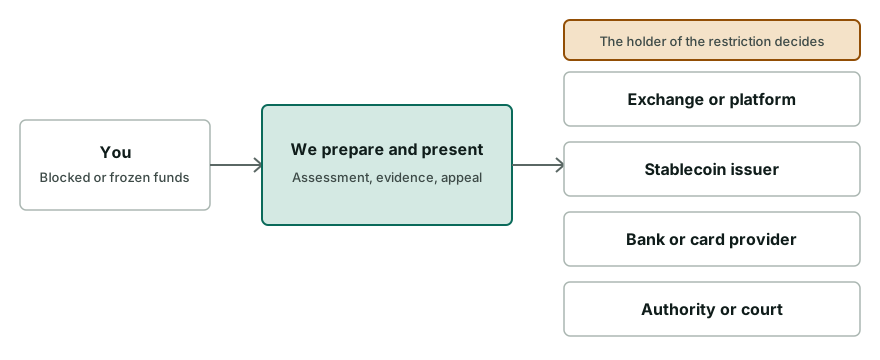
How the case runs
- Free assessment
You share the request and a short description of how the funds were obtained. We say in writing whether a pack is realistic and what records you need to find.
- Written scope and fee
If we proceed, you receive the scope and the fee model in writing before you pay anything.
- Collection
You provide documents through a secure channel. We list what is present, what is missing and which alternative records could stand in.
- Drafting and review
We assemble the pack and the narrative, then review it with you line by line and fix gaps and conflicts before it is sent.
- Submission and follow-up
You send the pack through the official channel of the exchange, bank or processor. We help with follow-up questions and tell you plainly if more is needed.
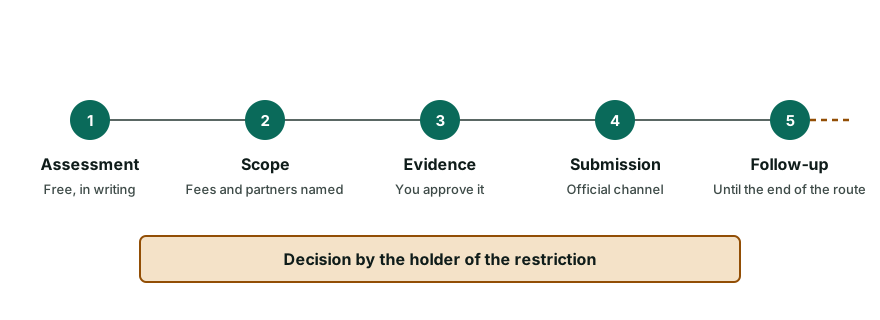
What to prepare
- Government photo ID and proof of address
- Bank statements showing the purchase or the incoming transfers
- Payslips, tax filings or invoices that show the income behind the funds
- Exchange account exports and trade histories, including closed accounts if available
- Mining statements, pool payouts and hardware purchase receipts
- Sale contracts, deeds or receipts for assets that were sold
- Gift letters or inheritance documents with the donor's details
- Wallet addresses you control and a short written timeline
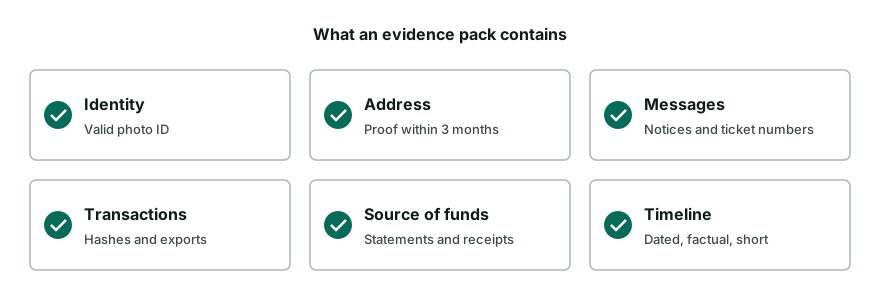
What we cannot do
- We cannot make an exchange, bank or processor accept a pack. The reviewer decides, within its own rules and the law that applies to it.
- We do not promise a result or a timeline.
- We will not create, alter or backdate a document, and we will not help hide the real origin of funds. If the evidence does not exist, we say so.
- We never ask for your seed phrase, private keys or passwords.
How long it takes
Gathering records usually takes the longest, especially from old exchanges or other countries. We estimate the time after the assessment and flag early which records may be slow to obtain.
Fees
The assessment is free. After it you receive a written scope and fee model. We do not ask for a fee before we have told you whether we can help. Fees →
Questions people ask
What is the difference between source of funds and source of wealth?
Source of funds explains where the money in a specific transaction or deposit came from. Source of wealth explains how you built your overall assets over time. Reviewers may ask for one or both, and the two stories must match.
What if I bought crypto years ago and have no receipts?
Many early buyers are in this position. Alternatives include bank records of the payment, old exchange emails or exports, wallet history on the blockchain and a clear written account. We help you find what exists and say honestly what cannot be proven.
Does mining income count as a valid source?
Usually yes, if it is documented. Reviewers like to see pool statements, wallet receipts, hardware purchase records and, where relevant, income reporting. The key is a clear line from mining rewards to the funds in question.
Can a gift or an inheritance be a source of funds?
Yes, with documents. For a gift, reviewers typically want a signed letter, the donor's identity and proof of where the donor got the funds. For an inheritance, they want legal papers confirming the estate and the transfer.
What happens if my explanation contradicts my documents?
The pack will probably be rejected and the review may become stricter. That is why we compare every date and amount before submission. If a detail is wrong, we correct the narrative, never the document.
Can I prepare a pack before I am asked for one?
Yes, and it is often wise before moving a large amount or opening a new account. A prepared pack saves days when a request arrives. It can be kept up to date as your activity changes.
Related situations
- Exchange account unblocking. Understand the freeze, prepare KYC/AML evidence, answer compliance and appeal.
- Crypto card and payment account blocks. Blocked crypto card, neobank or processor account: find the trigger, document it, appeal.
- Sanctions and AML false positive support. Wrong sanctions or AML match: evidence pack and a lawyer-filed statement to remove the flag.
- Crypto freeze diagnosis. Work out who froze your funds and what can realistically be done next.
Read next
Information on this page is general and not legal advice.