
How long does an exchange compliance review take? What sets the wait
Published: Last reviewed: Editorial policy
No exchange can promise one standard length, because the time depends on the reason for the review, how complete your answers are and how busy the team is. Kraken's help page says reviews usually take 10 to 14 business days. Coinbase's says restriction resolution typically takes up to 10 business days, and some cases take longer. The other platform help pages we read give no general review time.
Questions about your case? Message us:
What the official help pages say about timing
Many exchanges do not print a deadline for a compliance review, and none can promise one. Two help pages do give a rough range. They are the only time figures on this page. Use them to judge what is normal, then read your own exchange's current page, because help pages change.
The Coinbase figure comes from a page about restrictions that Coinbase links to security concerns, such as suspected malicious activity. It may not describe every kind of review. The Kraken page covers a wider set of temporary restrictions, including legal and regulatory requirements. Both pages allow that some cases take longer than the usual range.
The other platform help pages we read for this site give no general review time. A few state a time for one narrow step, such as a single kind of appeal, and that does not carry over to a full compliance review. Note the day your restriction began, so you can tell when a stated range has passed.
| Platform | What the help page says about time | What the page covers |
|---|---|---|
| Kraken | A review usually takes 10 to 14 business days and can take longer when it is busy. | Temporary restrictions, for example after unusual activity, outdated ID details, a payment reversal or a legal requirement. |
| Coinbase | Restriction resolution and review processing typically takes up to 10 business days, and some individual cases may take longer. | Account restrictions that the page links to security concerns. Coinbase says it emails you when the review is complete. |
| Other platforms | No general review time on the pages we read. | A few state a time for one narrow step only, such as one kind of appeal. |
What decides how long your review lasts
Two accounts under review can wait very different lengths of time. Some of the causes are outside your control. Others are not, so start with the answer you send and the documents behind it.
- The reason for the review. A request to refresh an identity check is often simpler than a question about where a large deposit came from.
- How complete your answer is. Missing pages, unreadable scans and skipped questions send the file back to you. Kraken's help page says partial answers can add days.
- Whether your documents agree. Names, dates and amounts that differ between files raise new questions.
- How busy the team is. Kraken's help page says a review can take longer when it is busy.
- Whether someone else is involved. If a court order or an authority request is behind the restriction, the exchange may have to wait for that body.
- How much there is to explain. A short, clean history is quicker to check than years of activity across many wallets and platforms.
The stages of a review and who is waiting for whom
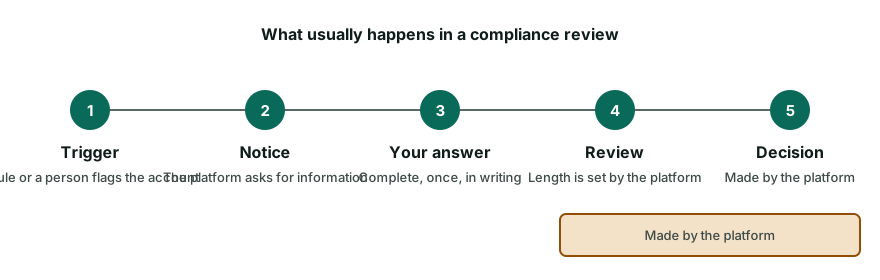
Exchanges describe their processes in different ways, so treat this as a general pattern and not as the procedure of one platform. Most reviews pass through the same steps. The wait is often longest at the stages where the exchange is waiting for you.
Use the table to see where your case probably stands. If the stage is yours, act first. If it belongs to the exchange, wait for the stated range before you follow up.
| Stage | What usually happens | Who is waiting | What you can do |
|---|---|---|---|
| Notice | The account is limited. A message or banner explains the reason in general terms, or only names a category. | You are waiting to understand it | Read it closely, note the deadline and the channel, and save a copy. |
| Request for information | The exchange asks for identity documents, proof of address or evidence of where the funds came from. | The exchange is waiting for you | Send one complete answer through the channel named in the notice, and keep the reference number. |
| Document check | A reviewer or an automated check compares your answer with what the account shows. | You are waiting for the exchange | Wait for the stated range, and avoid new transfers that add activity to explain. |
| Follow-up questions | The reviewer may ask for a missing page, a clearer scan or a short explanation. | The exchange is waiting for you | Answer exactly what is asked, in the same thread, as soon as you can. |
| Decision | The restriction is lifted, narrowed or kept in place, or the account is closed. | You are waiting for the exchange | Read the outcome. If the restriction stays, ask which information is still missing. |
| Appeal or escalation | Some exchanges offer a second review. Others publish no appeal route. | Depends on the exchange | Use the route named in the notice, and ask for the specific reason before you write again. |
What makes a review slower
Most delays come from a few repeated mistakes. Kraken's help page tells customers to answer every question in one go with clear, current documents, and it warns that partial answers can add days. That is sensible advice for any exchange. Check your own answer against the list below before you send it.
- Sending documents in pieces over several days, so the reviewer never sees a complete file.
- Scans that are cropped, blurred or out of date, or names that differ between documents.
- Answering a question the exchange did not ask while skipping the one it did.
- Opening several tickets about one case, which can scatter the replies across different threads.
- Moving funds around during the review, which adds new activity to explain.
- Angry or threatening messages. They add pages to read without adding facts.
- A legal request behind the restriction. The exchange may be unable to finish until the authority acts.
What to do while you wait
Waiting does not have to be passive. A short routine keeps your case clean and ready for the next question.
- Write down the date the restriction began, the date you answered and your reference number.
- Check your email, including the spam folder, and the exchange's app for new requests. Kraken's help page says it sends an email and an in-app notice if it needs more, and that many reviews finish without a request.
- Keep every message you received and every file you sent, with dates.
- Do not move funds or open a new account to get around the review. If the exchange says you may withdraw, follow its own instructions.
- If someone else may have used your account, follow the exchange's security steps. Kraken's page lists a password reset, removing unknown devices and checking two-factor authentication.
- After the stated range has passed, follow up once in the same thread. Quote your reference number and ask one specific question. Kraken's page suggests chat support if there is no word after more than 14 business days.
- Ignore anyone who contacts you first and offers to speed up the review for a fee. Never hand a seed phrase, private key or password to anyone.
When waiting is no longer enough
Some signs mean the case needs more than patience. The stated range has passed with no reply. The same documents are requested again and again. The notice names a legal request. A large amount is involved.
In those cases, ask the exchange in writing, in the same thread, which document or detail is still missing. If the exchange is regulated, a complaint to its regulator or ombudsman may be possible where such a route exists. A specialist can also check your file for gaps and draft a clear answer.
We can do that check at the free assessment stage. Before any fee comes up, we tell you in writing whether we can help. We cannot speed up the exchange or decide for it, and we never ask for a seed phrase, private key or password. If your review has run past the stated range, ask for the free assessment.
Common questions
Can I speed up an exchange compliance review?
Not directly. The exchange sets the pace, and nobody can force a decision. What you control is the quality of your answer: one complete package, consistent documents and the channel the exchange named. Those steps remove the most common causes of delay.
What if the review takes longer than the help page says?
Help pages describe typical cases, and both pages we read allow for longer ones. If the stated range has passed, follow up once in the same thread, quote your reference number and ask what is still needed. Keep every reply.
Does a long review mean the exchange suspects me of a crime?
Usually not. A long review often means the exchange is waiting for a document, a second check or an outside body. A request that comes from a court or an authority is a different matter, and the notice normally says so.
Do all exchanges publish how long a review takes?
No. Of the help pages we read for this site, only Kraken's and Coinbase's gave a general range. The others describe steps without a time, or give a time for one narrow process only. Read your own exchange's current page for the latest wording.
Should I send my documents again if I hear nothing?
Not unless the exchange asks. A second copy can scatter your case across two threads. Reply in the original thread with your reference number, and ask whether the documents arrived and whether anything is missing.
How we can help
- Exchange account unblocking. Understand the freeze, prepare KYC/AML evidence, answer compliance and appeal.
- Crypto freeze diagnosis. Work out who froze your funds and what can realistically be done next.
- Source of funds and source of wealth packs. Build a clear source of funds and source of wealth pack for exchanges, banks and processors.
- Regulator complaints and ombudsman filings. Prepare a structured regulator, ombudsman or consumer complaint with a clear chronology.
Sources
Official or authoritative pages this page is based on. Pages change, so check the source for the current wording.
- Why is my account restricted? · Kraken
- Resolve your account restriction · Coinbase
Information on this page is general and not legal advice.