
Funds frozen after a P2P trade: bank freezes, exchange holds and how to document the deal
Published: Last reviewed: Editorial policy
Funds get frozen after a P2P trade when the person you traded with is reported for fraud, or when the bank or exchange sees the payment as linked to a risky account. You may have done nothing wrong and still be caught. The way out is to show the trade was real: chat logs, receipts, payment proof and your own history. We help prepare that and the appeals.
Questions about your case? Message us:
This is for you if
- Your bank account was frozen after you received money from a P2P crypto buyer
- Your exchange account was restricted after you bought crypto from a P2P seller who was later reported
- A bank or police officer told you the incoming payment is linked to a fraud complaint
- You sold crypto in good faith and the buyer's bank has asked for the payment to be reversed
- You do not know how to prove that the trade was real and the payment was fair
Typical situations
- Bank freeze on the account that received a P2P payment
- Exchange freeze on coins bought from a counterparty who was reported as a scammer
- Chargeback or recall request from the other party's bank after the trade was complete
- Counterparty claims the payment was a mistake or was made under pressure
- Many small P2P trades in a short time flagged as unusual activity
- Funds restricted during a police inquiry into the other party's account
What we do
- Work out who froze the funds and why
A bank freeze, an exchange freeze and a police hold have different rules and different ways out. We read the notices and identify which party holds the funds, and under which type of request.
- Reconstruct the trade
We put the P2P deal in order: the advert, the chat, the agreed price, the payment confirmation and the release of the coins. A dated sequence is the strongest evidence that the trade was real.
- Show that you acted in good faith
We help you compile signs of normal behaviour: market-rate pricing, your identity checks, the platform's own records and your earlier history. A single trade looks very different when it is part of a clean pattern.
- Draft appeals to the bank and the exchange
We write a short, factual appeal for each party that quotes the reference, attaches the evidence and asks for a specific outcome, such as release of the funds or confirmation of what is needed.
- Coordinate lawyers when needed
If the bank or authority will not respond, or the amount justifies it, independent licensed lawyers can take legal steps. We prepare the file and keep the case coordinated.
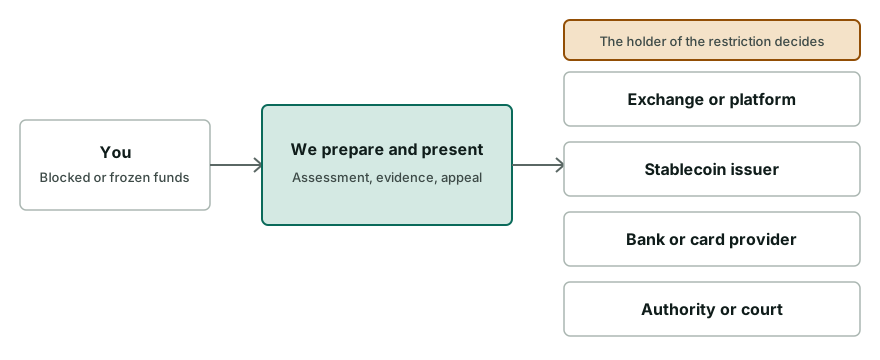
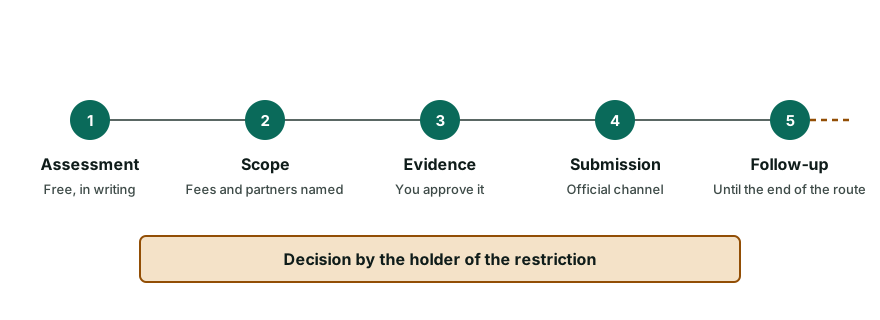
How the case runs
- Free assessment
You tell us what was frozen, by whom, and how the trade went. We say in writing whether we can help and what the likely route is.
- Written scope and fee
If we proceed, you receive the scope, the fee model and the independent specialists involved in writing before you pay anything.
- Evidence collection
You send the chat, receipts, bank statements and platform records through a secure channel. We check them for gaps and conflicts before anything is sent.
- Appeals
The appeals go through the official channels of the bank and the exchange. You receive copies and the reference numbers.
- Follow-up
We track replies, help with follow-up questions and tell you plainly if the case has reached the end of what can be done.
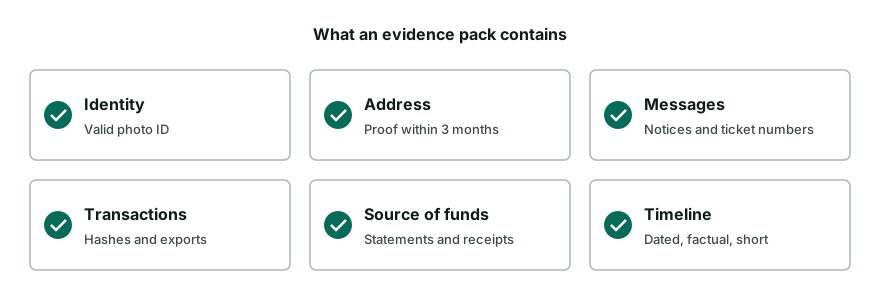
What to prepare
- Government photo ID and proof of address
- Screenshots or export of the P2P advert and the full chat with the counterparty
- Proof of payment from your bank or payment app, with date and amount
- The P2P platform's order record and release confirmation
- Exchange history showing the coins received or sent
- The notice from the bank or exchange with the reference number
- Your earlier P2P or trading history that shows normal behaviour
- A short written timeline of the trade
What we cannot do
- We cannot force a bank, an exchange or the police to release funds. They decide, under their own rules and the law that applies to them.
- We do not promise a result or a timeline. A frozen payment linked to a fraud case can stay on hold for a long time.
- We will not help you change or invent evidence, or hide a real link to fraud.
- We never ask for your seed phrase, private keys or passwords.
How long it takes
Bank and exchange reviews can last weeks, and a hold tied to a police inquiry can last longer. We give an estimate after the assessment and update it as the case moves.
Fees
The assessment is free. After it you receive a written scope and fee model for your case type. We do not ask for a fee before we have told you whether we can help. Fees →
Questions people ask
Why was my money frozen if I only did a normal P2P trade?
Banks and exchanges screen the accounts around a payment. If the other party was reported for fraud, or their account is under review, your payment can be caught in the same hold, even if you acted in good faith. You then have to show that the trade was genuine.
What is the strongest evidence that the trade was real?
A dated sequence is strongest: the advert, the full chat, the agreed price, the payment proof and the release of coins. Add the platform's order record and your own trading history. Missing or edited chat logs hurt the case.
Can the other party's bank reclaim the money?
In some cases a bank can recall or reverse a payment if the sender claims it was made by mistake or by fraud. Your answer should include the trade evidence. A lawyer may be needed if a large amount is claimed back.
Should I try to move the coins or the money elsewhere?
No. Moving funds that are under review can look like an attempt to hide them and may make the case harder. Keep the account as it is, answer the questions asked and keep every message.
How is a bank freeze different from an exchange freeze?
A bank freeze holds your fiat money and usually follows a fraud report, a court order or a bank's own risk rules. An exchange freeze holds your coins and usually follows a compliance review. Each has its own appeal route and sometimes both apply.
Do I need a lawyer?
Often not at first. A lawyer becomes useful if the bank or authority ignores the appeal, if a recall claim is made against you, or if the amount is large. Independent licensed lawyers handle the legal steps, and we tell you when that point is reached.
Related situations
- Exchange account unblocking. Understand the freeze, prepare KYC/AML evidence, answer compliance and appeal.
- Source of funds and source of wealth packs. Build a clear source of funds and source of wealth pack for exchanges, banks and processors.
- Crypto frozen by authorities. Assets held by authorities: we coordinate independent licensed lawyers. No legal advice.
- Crypto card and payment account blocks. Blocked crypto card, neobank or processor account: find the trigger, document it, appeal.
Read next
Sources
Official or authoritative pages this page is based on. Pages change, so check the source for the current wording.
Information on this page is general and not legal advice.